Wine Cellar Cooling Systems Compared: Through-the-Wall, Ducted, and Ductless Split
There are three main wine cellar cooling system types. A through-the-wall unit is self-contained and suits smaller cellars. A ducted system hides the equipment outside the cellar, so only grilles show. A ductless split pairs an evaporator inside with a remote condenser. The right choice depends on size, heat, noise, and glass. Decide before the millwork is designed.
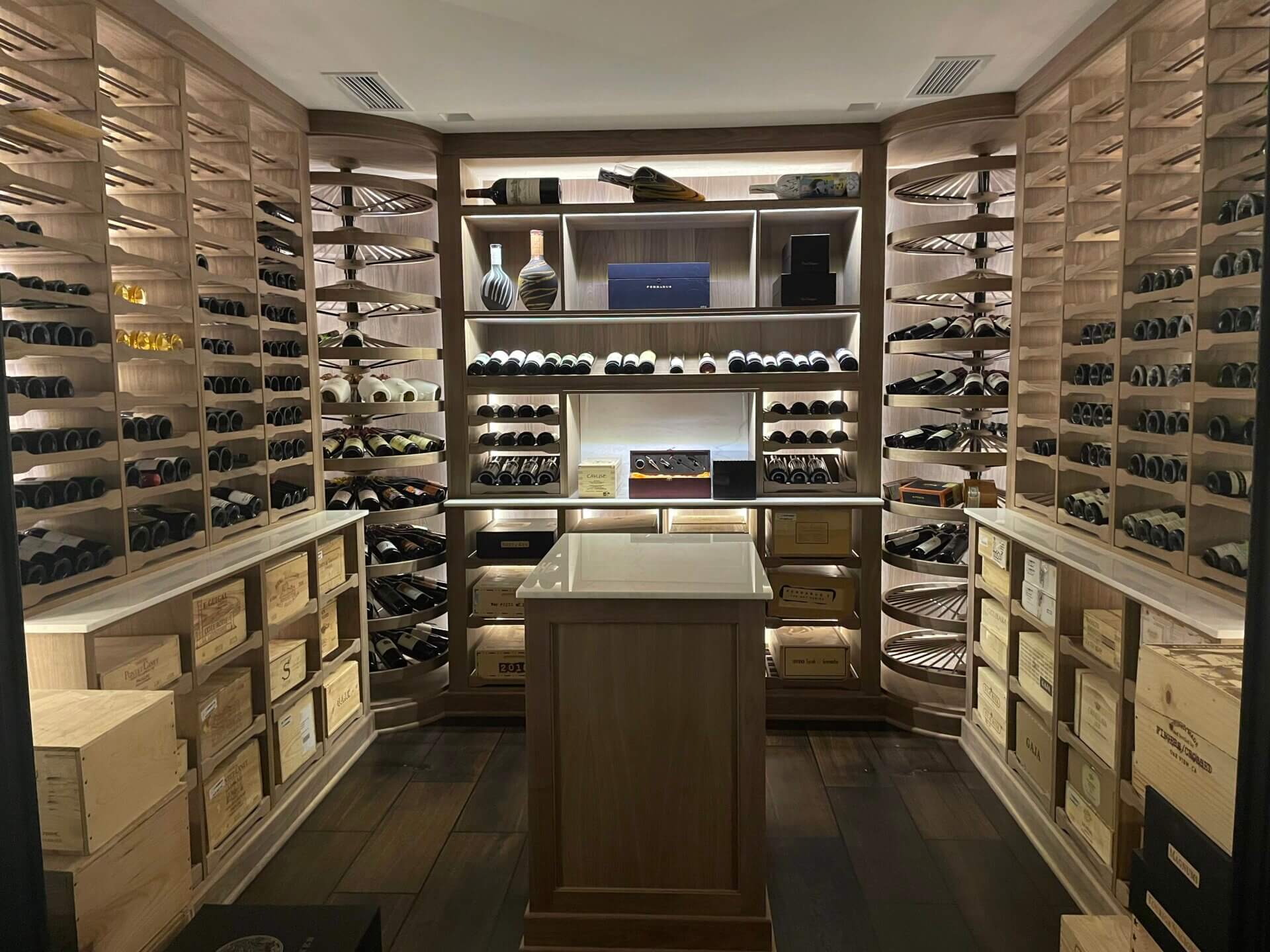
Cooling shapes what you see on the walls, what you hear inside, and where the heat pulled out of the cellar ends up. Revel’s construction guide notes that a cooling unit’s requirements “will depend on several factors, including cellar size, your ambient climate, your intended use, construction plans, etc.”
Do You Need a Wine Cellar Cooling System?
In most homes, yes. Revel’s FAQ is direct: “Unless you have a passive wine cellar environment able to keep the temperature and humidity at a consistent level, then including a cooling unit in your cellar is essential.”
A truly passive cellar, like the underground caverns European wineries have used for centuries, stays cool, damp, and dark without machinery. Few modern homes offer that, though a properly insulated, below-grade location can provide some of the benefits. For a room-by-room look at the trade-offs, see our guide to the best place in a home for a wine cellar. As that guide puts it, the cooling type follows “from where the room sits and what adjoins it.”
Setting up a conditioned cellar is also, in the FAQ’s words, “not for the novice do-it-yourselfer.”
Through-the-Wall (Self-Contained) Systems
A self-contained unit is mounted through one of the cellar walls. It blows cool air into the cellar and exhausts warm air out the back into the adjacent space.
- What shows in the cellar: the unit itself. Revel’s construction guide notes that self-contained systems “take up valuable space inside the cellar.”
- Economy and scale: these systems are “generally the most economical,” with more limited capacity. Revel’s FAQ describes them as best for smaller cellars.
- Noise: the construction guide calls them “the noisiest option.”
- Placement: the FAQ notes the unit shouldn’t interfere with the wine cabinets and racks.
The room on the other side of the wall matters too. Revel’s construction guide is emphatic: “Improper ventilation of the exhaust room is the most common mistake made in wine cellar construction.” If that room is allowed to get too hot, the cellar temperature rises with it.
Ducted Systems
A fully ducted system works much like home HVAC. The equipment sits in a remote location outside the cellar and connects to the room through supply and return ductwork, so only small grilles show inside.
Revel’s construction guide says they offer “the significant advantage of having no mechanical equipment inside the cellar,” and that they are “essentially silent within the cellar.” Revel’s FAQ adds that ducted systems offer maximum design flexibility.
In The Architect’s Guide to Planning a Custom Wine Cellar, Revel describes ducted systems as “The ‘gold standard’ for luxury projects.” Revel’s 12 Essential Tips for the Well-Designed Wine Cellar agrees: “When possible, use fully ducted cooling systems to avoid mechanical apparatus that needs to hang on a wall inside the cellar.”
Ductless Split Systems
A ductless split system mounts an evaporator inside the cellar and pairs it with a remote condensing unit. A line set (a liquid line and a suction line) connects the two, and the system also needs a drain line.
- Performance: Revel’s construction guide notes that split systems “can be quieter, longer lasting, more efficient and have greater cooling capacity than self-contained systems.”
- When it fits: Revel’s FAQ describes the ductless split as an option when ducting is not possible.
- Who installs it: a split system must be installed by a licensed professional.
Where the condensing unit goes is a site-specific decision to make with your cooling professional and architect.
Wine Cellar Cooling System Types at a Glance
| Through-the-wall (self-contained) | Ducted | Ductless split | |
|---|---|---|---|
| What shows in the cellar | The unit, set into a cellar wall | Only supply and return grilles | The evaporator |
| Where the heat goes | Into the adjacent exhaust room, which needs proper ventilation | To remote equipment outside the cellar, through ductwork | To a remote condensing unit, through a line set |
| Noise inside the cellar | “The noisiest option” | “Essentially silent within the cellar” | Can be quieter than self-contained |
| Space inside the cellar | Takes up wall space inside | No mechanical equipment inside | Evaporator inside |
| Who installs | Plan with your cooling professional | Plan with your HVAC or cooling professional | A licensed professional |
| Design flexibility | Placement must work around cabinets and racks | Maximum design flexibility | An option when ducting isn’t possible |
Planning a new cellar? Start the conversation with Revel.
Quiet Cellars and Where the Noise Goes
Every cooling system makes some noise; the design question is where it lives. A through-the-wall unit’s condenser side faces the adjoining room, so both spaces hear it. A split keeps only the evaporator in the cellar, and a fully ducted system moves all of the mechanical equipment out of the room. If the cellar adjoins a dining room, tasting room, or main living space, decide early which rooms can accept the equipment.
Glass Rooms and Cooling

Glass-enclosed cellars bring the collection into view, and they change the cooling equation. Revel’s construction guide notes that the proportion of glass in the cellar envelope must be “factored into the heat loss calculation when selecting the cooling system.” Solid glass without framing can diminish thermal performance, both in temperature and humidity control. The guide strongly urges consulting a qualified glass professional to help design the enclosure.
Heat-load planning for glass belongs with that professional and your cooling specialist. For design inspiration, explore Revel’s glass-enclosed cellars and our look at the rise of modern glass wine walls.
The Enclosure Comes First
No cooling system can make up for a leaky room. Revel’s construction guide describes building a wine cellar “the way refrigerators are built, with mechanical cooling units and a very efficient ‘enclosure.'”
- Vapor barrier: “A vapor barrier is critical to controlling the humidity inside your wine cellar.” Sprayed-in, closed-cell foam can serve as both insulation and a moisture barrier. Other insulation types need a separate vapor barrier.
- Insulation: walls and ceilings must be insulated. In general, thicker insulation means better cooling.
- A sealed door: the door “is often the weakest link.” When a cellar isn’t sealed, cooling units can end up “running continually (not a good thing!) and burning out prematurely.” The guide recommends an exterior-grade door with weather-stripping on all four sides.
The wine cellar construction guide covers each step in detail.
Decide on Cooling Before the Millwork
The Architect’s Guide says the cooling decision “must be made during the schematic design phase,” because it dictates the ductwork and electrical requirements. Its site-prep checklist includes a dedicated circuit for the cooling unit and a dedicated condensate drain line.
Deciding early also settles questions that shape the cabinetry:
- Which room the heat will vent into, and whether it can be properly ventilated
- Where any unit, evaporator, or grilles will sit relative to the racks and cabinets
- The electrical and plumbing rough-in, which the construction guide says should go in before insulation
- Whether systems can be operational, as the guide recommends where possible, before racking or cabinetry is installed and the collection is brought in
The team is typically your architect, your HVAC or cooling professional, and Revel, whose part is the cabinetry. Through our design approach, Revel’s design team works with you, your interior designer, architect, and builder, producing 2-D drawings, including a floor plan and detailed elevations, so that label-forward cellar elements such as Sliding Pullout Drawers are planned around the cooling layout. Your cooling professional specifies and sizes the system itself. As our location guide advises, look case by case “before you commit millwork.” To bring Revel into that conversation, request a consultation.
Custom Cellar vs. Wine Fridge
A wine fridge is an appliance that cools what fits inside the box. A custom cellar is a conditioned room, with cooling planned as part of its enclosure and design. As we wrote in custom wine cellar vs. wine fridge, “The goal is stability—not just ‘cold.'” For collectors without room for a walk-in cellar, Revel’s self-contained Wine Vault offers a smaller-scale alternative.
Frequently Asked Questions About Wine Cellar Cooling
There are three main types. A through-the-wall unit is self-contained, mounted in a cellar wall, and exhausts heat into the adjacent room. A ducted system places equipment outside the cellar, leaving only grilles inside. A ductless split pairs an evaporator inside the cellar with a remote condensing unit, connected by a line set.
Almost always. Revel’s FAQ says that unless you have a passive wine cellar environment able to keep the temperature and humidity at a consistent level, including a cooling unit in your cellar is essential. Few modern homes offer truly passive conditions, though a well-insulated, below-grade location can provide some of the benefits.
Inside the cellar, a fully ducted system is typically the quietest. Revel’s construction guide describes ducted systems as essentially silent within the cellar, because no mechanical equipment sits inside the room. Split systems can be quieter than self-contained units, which the guide calls the noisiest option. Plan where the equipment noise will go.
It depends on the type. A through-the-wall unit exhausts heat into the adjoining exhaust room, which must be properly ventilated. Revel calls poor exhaust-room ventilation the most common mistake in wine cellar construction. A ducted system’s equipment sits outside the cellar, and a split sends heat to a remote condensing unit, placed as planned with your cooling professional.
A split system must be installed by a licensed professional. It connects an evaporator inside the cellar to a remote condensing unit through a line set, and it also requires a drain line. Coordinate the installation with your architect and cooling professional early, since the line set, drain, and electrical all affect the cellar layout.
Ask a cooling professional. Revel’s construction guide recommends contacting a professional to ensure you get the cooling unit right for your cellar. The requirements depend on factors including cellar size, ambient climate, intended use, and construction plans. Glass matters too, since its proportion of the envelope must be factored into the heat loss calculation.
Early. Revel’s Architect’s Guide says the cooling decision must be made during the schematic design phase, because it dictates ductwork and electrical requirements. Decide before the millwork is designed, so the dedicated circuit, condensate drain line, venting, and equipment placement are coordinated with the cabinetry layout from the start.
Plan Your Cellar’s Cooling and Millwork Together
The best cellars feel effortless because the cooling layout, the enclosure, and the label-forward cabinetry were planned early, as one design. Revel builds the cabinetry; your cooling professional handles the system. When you are ready to plan, request a consultation and tell us about your space.