Glass-Enclosed Wine Cellars: Design, Climate, and Display Requirements
Glass enclosed wine cellar design showcases the collection while holding about a constant 55 degrees and about 70 percent humidity. That takes insulated, dual-pane, tempered, UV-filtering glass, specified by a glass professional, plus a sealed door, low-heat, low-UV LED lighting and cooling planned for the glass. Revel designs the cabinetry and provides a glass specification your fabricator finalizes.
Revel’s own gallery describes glass-enclosed wine cellars as “where form meets function—creating a dramatic focal point that turns your collection into art.” Our guide to the best place in a home for a wine cellar adds the other half of the story: “Done well, these rooms showcase label-forward storage and make the collection part of the architecture. Done poorly, glass becomes the weak link for temperature, humidity, and UV.” This guide covers what the glass, the seal, the cooling and the lighting each need to do, and how label-forward cabinetry makes the view worth having.
Why Glass Cellars Moved into the Main Living Space
The cellar used to be hidden downstairs. Today it’s often part of the main living sequence. Revel’s history notes that its clients “typically seek to incorporate glass into the entry systems and enclosures to promote views into their cellars from adjacent living areas and enhance the overall experience.” Founder Jim Cash has described the biggest shift as the cellar becoming an entertainment hub, which led to more contemporary designs and glass walls and doors that open a view into the cellar.
Revel’s design trends for 2025 put it simply: “Glass-enclosed designs are trending, turning wine collections into stunning showpieces.” And as Revel’s 10 things to avoid when designing a wine cellar explains, “Modern glass technology has come a long way, to a point where it is perfectly acceptable to incorporate glass doors, windows, wall sections, etc.”

What a Glass Wine Cellar Needs to Protect Wine
Glass brings real challenges. Revel’s wine cellar construction guide notes that glass “creates challenges in terms of energy efficiency and infiltration of damaging ultra violet light penetration,” and that “Recent advances in glass technology have made it possible to address these challenges, at least in part.” That “at least in part” is the honest starting point: glass can work beautifully, but good glass enclosed wine cellar design plans every part of the room around it.
Glass that insulates and helps filter UV
Revel’s recommendation is insulated, dual-pane, tempered, UV-filtering glass, specified by a glass professional. Revel’s Architect’s Guide sets the baseline: “If the design includes a glass wall, it must be thermally insulated, dual-pane, and UV-coated.” Our post on modern glass wine walls explains why: “Because glass is a poor insulator compared to a traditional wall, you must spec the right materials.”
UV-coated wine cellar glass helps filter UV, but no glass makes light a non-issue. The exact glazing, safety requirements and local code belong with your glass professional. The construction guide is direct on this point: “We strongly urge you to consult with a qualified glass professional to assist in the design of the enclosure.” Revel doesn’t supply or install the glass. It provides a glass specification that your glass fabricator finalizes and builds, and it can recommend trusted glass partners.
Framed, steel-framed or solid glass: the trade-off
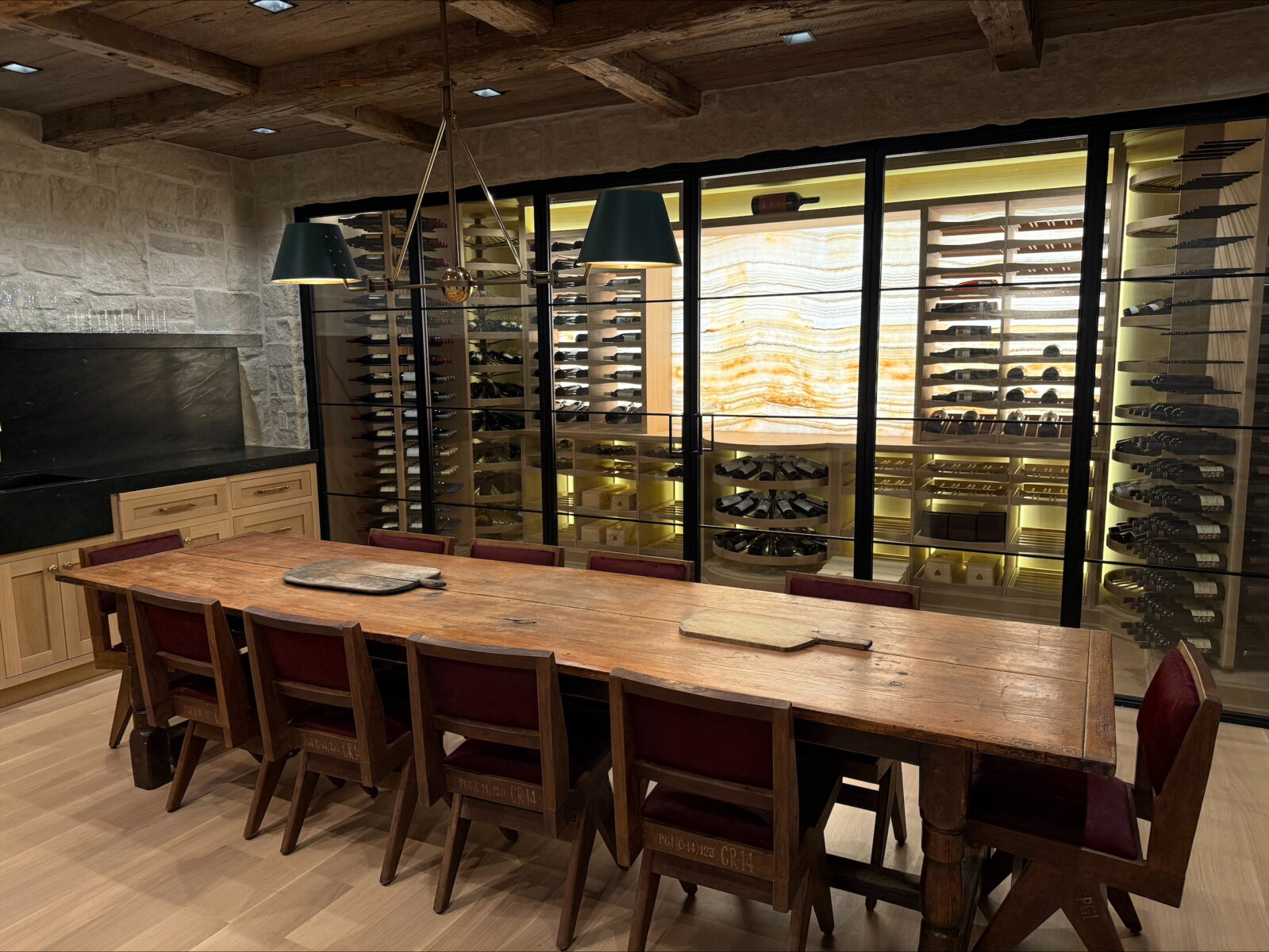
How much glass you see and how well the room holds its conditions move in opposite directions. Revel’s post on glass-enclosed wine cellars lays out the spectrum: “Going from the least to the most visibility also goes conversely from most to least energy efficient. Glass windows in a traditionally framed wall or door is the best in terms of thermal performance.”
- Framed glass gives the best thermal performance and the least glass coverage. The construction guide notes that double-paned glazing “must be contained in a framing system that will become part of the visual effect of the cellar.”
- Steel-framed glass opens up the view. “Steel framed glass doors and walls will allow more glass because the framing members can be thinner,” with “a slight degradation in thermal performance compared to wood.”
- Solid panel glass offers the cleanest look. “Solid panel glass doors and walls provide completely unobstructed views,” but, as the construction guide puts it, “thermal performance may be diminished, both in terms of temperature and humidity control.”
Frameless and solid glass doors are harder to seal as tightly as a framed door, so the seal becomes a design trade-off the team plans for from the first drawings. Revel projects show the range, from frameless glass doors to floor-to-ceiling glass doors.
The rest of the envelope still matters
The glass is only one surface. The glass wine walls post is clear that “Even with a glass front, the surrounding walls and ceiling must be perfectly insulated with a proper vapor barrier.” The door matters just as much. The construction guide warns that “the cellar door is often the weakest link” and advises: “We recommend an exterior grade door with weather-stripping on all four sides. We also recommend the use of a sweep or threshold to form a tight seal.” The Architect’s Guide calls for “exterior-grade doors with automatic ‘drop-down’ seals and weather-stripping.”
Where a wood door fits the design, Revel’s FAQ notes: “We can design and fabricate beautiful wood framed doors that will provide a tight, protective seal for your wine cellar.”
Condensation and UV: realistic expectations
Insulated, dual-pane glass helps limit condensation, and UV-filtering glass helps filter UV. Neither is a guarantee on its own. How a glass wall performs depends on the whole design: the glass, the seal, the rest of the envelope and the cooling. That’s why the glass professional and the cooling professional should be part of the plan early.
Cooling a Glass Wine Cellar
Glass changes the cooling plan. The construction guide explains that “The proportion of glass in the cellar envelope will need to be factored into the heat loss calculation when selecting the cooling system.” For solid glass designs, it adds that “a highly skilled and specialized glass fabricator is a must” and that “this will need to be factored into the cooling system planning.”
Timing matters too. The Architect’s Guide advises that “Choosing a cooling system is a decision that must be made during the schematic design phase, as it dictates your ductwork and electrical requirements.” For glass rooms, it singles out ducted systems: “The ‘gold standard’ for luxury projects. These systems are hidden entirely, with only small, discreet supply and return grilles visible in the cellar. This is essential for the ‘minimalist glass box’ aesthetic.” A split system should be installed by a licensed professional.
Heat-load planning belongs with your cooling professional and your glass professional. Our guide to wine cellar cooling systems compares through-the-wall, ducted and ductless split systems, including how glass rooms change the cooling equation. Because the glass has to be factored into the cooling plan at schematic design, bring floor plans or renderings that show where the glass will go to your first consultation.
Lighting the Collection
In a glass room, lighting is part of the view. Revel’s guidance is low-heat, low-UV LED lighting. The Architect’s Guide recommends: “Use integrated vertical light strips within the cabinetry.” Revel’s post on the role of lighting in a wine cellar notes that “Glass-enclosed cellars benefit from subtle perimeter lighting to define the space without glare,” and advises on color temperature: “Aim for 2700K–3000K (a warm white).”
Revel’s FAQ adds that “low voltage fixtures should be used as well as dimmer switches to control brightness.” The result is a cellar that glows from within, with the bottles as the focal point.
Label-Forward Cabinetry in Glass Enclosed Wine Cellar Design
Glass only pays off if there’s something worth seeing behind it. As Revel puts it, “In general, the use of glass will limit the use of that space for wine storage, but we have come up with several solutions that work beautifully against glass. However, it can’t be just any glass. Thermal characteristics and UV light filtration must be considered in the design.”
Revel-ution Towers against glass
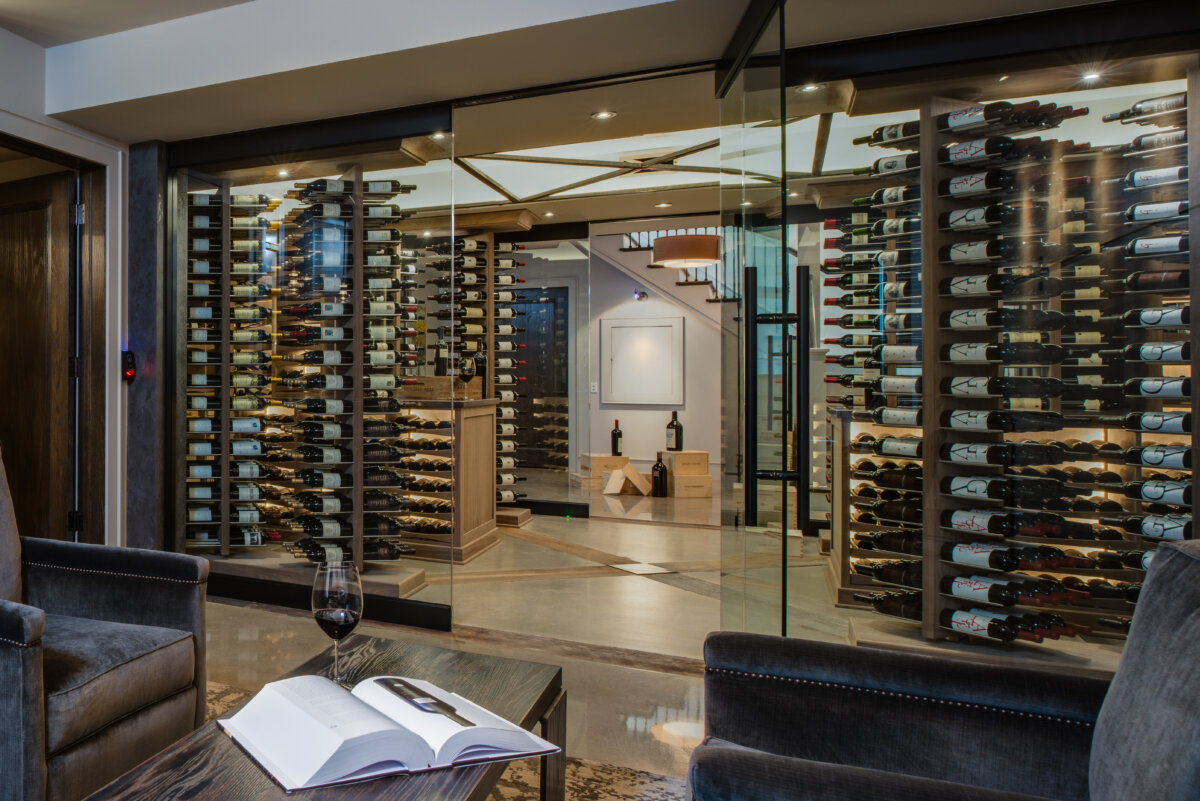
Revel-ution Towers suit glass walls because they can be reached from either side. “The panels can also be made to either slide or rotate. This system allows easy bottle access from either the front or the rear.” In Revel’s Charlevoix, Michigan cellar, “Revel-ution Towers comprised of walnut panels and stainless dowels line the front and back glass walls.”
Glass wine walls and sliding drawers
Not every glass project is a walk-in room. Shallow glass wine walls are covered in our post on the rise of modern glass wine walls, which notes that “By using Revel’s patented sliding system, you can store bottles multiple layers deep.” Revel’s Sliding Pullout Drawers keep labels facing out, so the collection reads clearly through the glass.
Wine Wheel in the corners
Corners are easy to waste in any cellar. The Wine Wheel puts them to work: as our Wine Wheel guide explains, “you turn the wheel by hand to bring the bottle you want around to you. There is no motor.” Revel’s glass-encased Mountain Chic cellar in Missouri places “wine wheel towers in the back corners.”
Designer Series for ultra-modern glass rooms
For the most contemporary rooms, Revel’s Designer Series towers take a different form. “It incorporates new materials such as aluminum, bamboo, and acrylic,” and “The bottles will be oriented on their sides with the labels facing outwards for ease of identification.” In Key Biscayne, Florida, chrome-plated Designer Series towers with fully rotating plates fill an “ultra-modern glass-enclosed wine cellar” that is “the striking focal point in this modern kitchen.”
Designing a glass room? Which systems work against your glass depends on wall depth, front or rear access and how many bottles you keep. Share your floor plans or renderings and your bottle count, and we’ll design the cabinetry around the glass in your design drawings.
Taste Outside, View Through the Glass
A glass cellar doesn’t need to be a place to linger. The construction guide recommends that “It works much better to design a tasting room or entertainment area adjacent to the cellar, and if the view of the cellar is integral to the overall design, the spaces can be divided by a floor-to-ceiling glass wall and integrated door system.” Revel’s 12 Essential Tips say the same: “put some glass in the front and create a tasting area with views into the cellar.”
There’s a practical benefit, too. The glass-enclosed cellars post notes that “we can separate the tasting and consuming of wine from the storage and aging of wine by incorporating glass. This allows the conditioned ‘cellar space’ to be smaller.” At The Founders Room at Brush Creek Farms in Wyoming, “Floor to ceiling glass doors separate the cellar from the private dining room so that guests have full view of the wine collection.”

Glass-Enclosed Projects for Inspiration
Revel’s glass-enclosed gallery shows how differently a modern glass wine room can come together:
- Naperville, Illinois: a basement renovation that expanded a small wine cellar into a large walk-in cellar with a glass enclosure.
- Key Biscayne, Florida: an ultra-modern glass-enclosed cellar as the focal point of a modern kitchen.
- Mountain Chic, Missouri: “Encased in sleek glass, the space is crafted from premium white oak.”
- Charlevoix, Michigan: Revel-ution Towers lining the front and back glass walls.
- West Bloomfield, Michigan: “Revel’s signature pullout drawer technology with soft LED lighting, frameless glass doors, and furniture-grade walnut cabinetry.”
- Brush Creek Farms, Wyoming: floor-to-ceiling glass doors between the cellar and the private dining room.
- Nashville, Tennessee: a collection stored behind a glass-enclosed wall.
For more styles, browse all of Revel’s work.
Plan Glass Enclosed Wine Cellar Design with the Right Team
A glass cellar is a team project. Your architect shapes the room, Revel prepares a glass specification for a qualified glass fabricator to finalize and build, a cooling professional plans the system, and Revel designs the cabinetry that brings the collection forward. If you don’t have a glass fabricator yet, Revel can point you to partners it trusts. The Architect’s Guide covers the early decisions design teams should make, and Revel’s design approach starts with consultation, then moves to computerized 2-D drawings, including a floor plan and detailed elevations.
If location is still open, our guide to the best place in a home for a wine cellar advises: “If glass is central to the vision, involve a qualified glass professional early and size cooling for the real heat load.” For smaller spaces, Revel’s Wine Vault is a “self-contained wine vault designed for discriminating collectors,” and the product page describes it as “a smaller-scale solution” for collectors with a full cellar elsewhere.
Frequently Asked Questions About Glass-Enclosed Wine Cellars
A glass wine cellar needs insulated, dual-pane, tempered, UV-filtering glass, specified by a glass professional, plus an insulated envelope with a vapor barrier, a well-sealed door, low-heat, low-UV LED lighting and cooling planned for the glass. Together, these help the room hold about a constant 55 degrees and about 70 percent humidity.
Revel recommends insulated, dual-pane, tempered, UV-filtering glass, specified by a glass professional. Revel provides a glass specification, and your glass fabricator finalizes the glazing details, safety requirements and local code, then builds the glass. Revel does not supply or install glass, but it can recommend trusted glass partners early in the design.
They can. Insulated, dual-pane glass helps limit condensation, but no glass guarantees a clear surface in every condition. The best approach is planning: an insulated, well-sealed enclosure, glass specified by a glass professional, and cooling chosen with the glass in mind by a cooling professional, all coordinated early in the design.
Glass changes the cooling plan. Revel’s construction guide says the proportion of glass in the cellar envelope must be factored into the heat loss calculation when selecting the cooling system. Decide cooling during schematic design with a cooling professional. Ducted systems, which leave only small grilles visible, suit a minimalist glass room.
Yes. Revel projects include frameless and floor-to-ceiling glass doors, made by a glass fabricator rather than Revel. The trade-off is that more glass and less framing give the most visibility but less thermal performance, and a solid glass door is harder to seal fully. The design team plans for that balance from the start.
Use low-heat, low-UV LED lighting. Revel’s Architect’s Guide recommends integrated vertical light strips within the cabinetry, and Revel’s lighting guide notes that glass-enclosed cellars benefit from subtle perimeter lighting to define the space without glare. Aim for a warm white of 2700K to 3000K, with low voltage fixtures and dimmer switches.
Revel recommends tasting outside the cellar. A tasting room or entertainment area next to the cellar, divided by a floor-to-ceiling glass wall and door, keeps the view while the wine stays in its conditioned space. It also lets the cellar itself be smaller, since guests gather in a comfortable room next door.
Plan Your Glass-Enclosed Wine Cellar with Revel
When you’re ready, request a consultation and choose Project Inquiry. Upload floor plans, elevations or renderings that show where the glass will go, and include your approximate bottle count, the room’s dimensions and where the project stands. Glass enclosed wine cellar design works when the glass, the seal, the cooling, the lighting and the cabinetry are planned together, and Revel’s design team works with you, your architect, builder, interior designer and glass professional on label-forward cabinetry that turns the collection into the view.