What Affects Custom Wine Cellar Cost? A Planning Factor Guide (Not a Price List)
There’s no one-size price for a custom wine cellar. The main custom wine cellar cost factors are bottle count and room size, how the space is prepared and cooled, the cabinetry systems and wood species, doors and glass, lighting, and installation. Revel’s design process turns those choices into 2-D drawings and a final cost proposal.
The only accurate price is one built from your design. The first consultation is free. Choose Project Inquiry and tell us about your space.
This guide walks through each factor Revel’s own pages describe, so you can plan with clear expectations. It is not a price list. Every Revel cellar is designed and built to order, and the real number comes from your design.
Why There’s No One-Size Price
Every cellar balances competing goals. Revel’s 12 Essential Tips puts it this way: “It is a good idea to balance the cost of the room, with the value of the collection, and the number of bottles.” In The Art of the Wine Cellar, Revel’s Jim Cash talks about “aligning expectations at the outset so there is no sticker shock when the proposal is presented. You have to balance cost, capacity and visual impact.”
That’s why we ask for your approximate bottle count and square footage up front. The first consultation is free. Choose Project Inquiry on the inquiry form to share approximate square footage and bottle count, and to upload floor plans or images.
A single per-bottle or per-square-foot number hides those trade-offs. For the room-side work behind them, see Revel’s wine cellar construction guide.
Size and Bottle Count
Bottle count shapes the whole design. Revel’s design process notes that “The design will also confirm the bottle count and the molding and trim styles.” The construction guide adds: “Also consider your collecting plans in terms of storage for full cases, large format bottles and half bottles.” Revel’s FAQ says, “We can also create custom wine storage that will fit large trophy bottles such as Jeroboams and more.”
Where the Cellar Goes and How the Space Is Prepared
Location matters before any cabinetry is built. According to the construction guide, “the location of a wine cellar can provide some of the benefits of a passive cellar, thus reducing the cost of mechanical systems and increasing their reliability.” It also advises, “Your wine cellar should be constructed to exact dimensions of the wine cabinetry or racking to go inside.”
Revel’s custom cellar vs. wine fridge comparison lists the cellar’s cost factors as “Space prep (insulation, vapor barrier, cooling, door), custom millwork, design coordination” and a “higher upfront investment.” The room is designed to hold something on the order of a constant 55 degrees and about 70 percent humidity. For help choosing the room, see the best place in your home for a wine cellar.
Cooling Approach
Cooling is one of the custom wine cellar cost factors to settle early. The construction guide says self-contained through-the-wall systems “are generally the most economical, but also have important disadvantages. They take up valuable space inside the cellar, they generally have more limited capacity, and they are the noisiest option.” Split systems are installed by a licensed professional.
Revel’s cooling systems guide cites the Architect’s Guide: the cooling decision “must be made during the schematic design phase.” As that guide puts it, “Revel builds the cabinetry; your cooling professional handles the system.”
Cabinetry Systems: The Biggest Design Choice
The construction guide notes that “Alternatives vary dramatically based on style, cost, functionality, materials and quality. Care should be taken to ensure that the choice you make not only fits your budget, but also functions well for the intended use of the cellar, and accommodates your collection properly.” Revel’s systems, shown on the Elements page, each do a different job:
- Sliding Pullout Drawers let you “store multiple bottle sizes side-by-side, from 375 mL bottles to magnums.” See our pullout drawers guide.
- The Wine Wheel “optimizes your storage capacity by utilizing otherwise wasted corner space.” It is turned by hand. More in our Wine Wheel guide.
- Revel-ution towers: “Each panel can rotate up to 360˚ and can come 3 or 4 bottles deep.”
- Reveal has “no moving components” and is “Available in either all wood or a combination of steel and wood.”
- The Rotating Designer Series “incorporates new materials such as aluminum, bamboo, and acrylic.”
- Wine ladders “can be customized to allow more bottles per row, depending on the space constraints.”
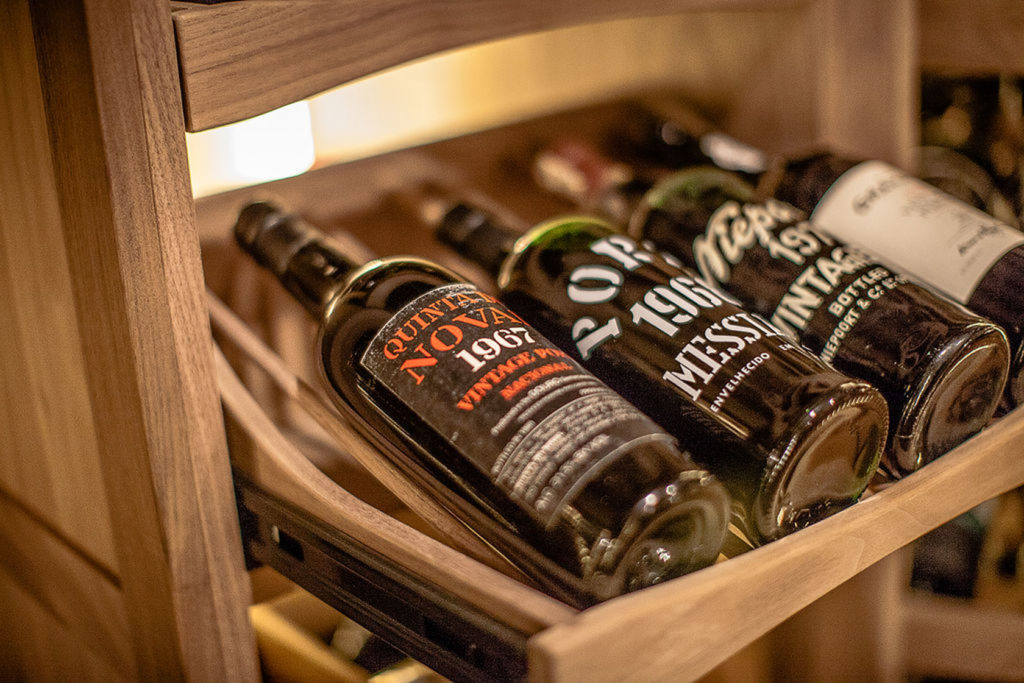
System choice is one of the biggest custom wine cellar cost factors. The first consultation is free. Choose Project Inquiry, share the approximate square footage and bottle count, and upload floor plans or images; the design and proposal reflect the systems you choose.
Wood Species and Materials
Revel’s FAQ says, “Hardwoods are the optimum choice for use in wine cellars,” and “Mahogany, walnut, cherry, white oak, maple and hickory are all excellent choices.” Revel’s pages don’t rank species by cost, and neither does this guide. For more, read the ultimate guide to wine cellar materials and why unfinished hardwoods matter.
Doors and Glass
Every cellar needs a proper entry. Revel’s FAQ explains, “Every cellar needs an exterior grade door capable of keeping the conditioned air inside from escaping. We can design and fabricate beautiful wood framed doors that will provide a tight, protective seal for your wine cellar.” The Wine Cellar Doors page adds, “We can create a custom wine cellar entry system from simple to extravagant, based on your aesthetic preferences.”
Glass changes the scope. Revel’s glass-enclosed cellars article notes that “a full glass wall system is more complex construction involving costlier materials and time spent in measurement, design, and installation.” Revel’s guidance is insulated, dual-pane, tempered, UV-filtering glass, specified by a glass professional. Revel provides the glass specification, and your glass fabricator builds and installs the glass. See finished rooms in Revel’s glass gallery.

Planning a glass wall or door? Revel provides the glass specification for your design; your glass fabricator builds and installs it.
Lighting
Lighting is usually built in. Revel’s About page says, “Nearly all of the wine cellars we build include built-in, pre-installed LED lighting into the cabinetry.” For design ideas, see the role of lighting in a wine cellar.

Design Complexity and Customization
Revel designs for the long term. In a 2023 post on balancing design preferences, Revel writes, “we want them to always feel comfortable with the investment they made in one of our cellars. This is much more important than any immediate financial consideration.”
Shipping, Installation and Where You Live
How your cellar is installed is part of the plan. Revel’s process page explains, “Since our cellars are shipped fully assembled, this allows clients to avoid the cost of travel, room and board for us to send our own technicians.” It continues, “Typically, our clients engage the services of their contractor’s personnel to complete the installation. We can also provide delivery and installation services upon request for local customers.” The installation “is quite similar to that of installing fine kitchen cabinetry.” In Revel’s Melbourne, Australia project, the cellar was “installed by the contractor’s on-site personnel.” All Revel cellars are built in Holland, Michigan. For projects outside Michigan, Revel works with a team on the receiving end: components ship fully assembled, and a contractor installs them. Local delivery and installation are available on request; Revel does not publish a service radius.
Timeline and Deposit
Revel’s process page states both plainly: “To initiate production, we will collect a 50% deposit.” And: “The construction timeline is around 7-12 weeks.” That timeline covers building the cabinetry after you sign off on the design, not the whole project. After the 50% production deposit, the balance is due once production is completed, before shipping. After the design deposit and dimensions are in hand, the first design typically arrives in about a week, then revisions follow; the 7-12 week construction lead time begins after sign-off.
How a Consultation Produces a Real Proposal
Revel’s process starts with you: “We begin by determining your needs and discussing the vision for your new wine cellar.” Then, “After the initial consultation has been completed, and we are retained to create a design, our design professionals will produce your cellar layout with computerized 2-D drawings including a floor plan and detailed elevations.” There is a design deposit, and design work begins once it is received. Computerized 2-D drawings are standard; renderings are available at additional cost.
Frequently Asked Questions About Custom Wine Cellar Cost
There is no one-size price. Cost depends on bottle count, where the room is and how it is prepared, the cooling approach, the cabinetry systems, wood, doors and glass, lighting and installation. Revel designs each cellar to order, produces 2-D drawings, and then prepares a final cost proposal for your project.
The cabinetry systems and materials you choose, together with how the room is prepared and cooled, shape cost the most. Revel’s construction guide notes that alternatives vary dramatically based on style, cost, functionality, materials and quality, so the right choice fits your budget, your use of the cellar and your collection.
Revel’s construction guide says self-contained through-the-wall systems are generally the most economical, but also have important disadvantages: they take up space inside the cellar, generally have more limited capacity and are the noisiest option. Decide on cooling early, during schematic design, with your cooling professional, because Revel builds the cabinetry around it.
Revel’s glass article notes that a full glass wall is more complex construction involving costlier materials and time spent in measurement, design and installation. Revel’s guidance is insulated, dual-pane, tempered, UV-filtering glass, specified by a glass professional. Revel provides the glass specification, and your glass fabricator builds and installs the glass.
Yes. Revel cellars ship fully assembled, and typically clients engage their contractor’s personnel to complete the installation, which is quite similar to installing fine kitchen cabinetry. Outside Michigan, Revel works with a team on the receiving end, and a contractor installs. Local delivery and installation are available on request.
Yes. There is a design deposit, and design work begins once it is received. To initiate production, Revel collects a 50% deposit after the design is finalized for signature. The balance is due once production is completed and before shipping.
Revel’s process page says the construction timeline is around 7-12 weeks. That covers building the cellar cabinetry at Revel’s shop in Holland, Michigan, after you sign off on the design. The first design typically arrives about a week after the design deposit and dimensions are in hand, then revisions follow. Room preparation, shipping and installation are separate.
Start with a free consultation. Revel reviews your space and how you plan to use the cellar, then produces 2-D drawings including a floor plan and detailed elevations that confirm the bottle count. Renderings are available at additional cost. From there, Revel fine-tunes the design and prepares a final cost proposal.
Plan Around Your Custom Wine Cellar Cost Factors
When you’re ready, request a consultation — the first consultation is free — and choose Project Inquiry. Share your approximate square footage and bottle count, and upload floor plans or images. Revel will fine-tune the design and prepare a final cost proposal for your project. Architects, interior designers and builders are welcome to reach out on a client’s behalf and send plans. For inspiration, browse Revel’s work.